Needles For B12 Injection What size needles for B12 injections?
What Size Needles for B12 Injections? A Consumer-Review Guide to Length, Gauge, and Fit
If you’re asking what size needles for B12 injections, you’re not alone. After a clinician recommends B12—often for low levels, dietary insufficiency, or certain absorption concerns—many young women run into the same practical problem: the vial (or prefilled syringe) comes with instructions, but the needle details may be scattered across paperwork, pharmacy labels, or online discussions.
Search intent is usually a mix of “what fits my dose,” “which needle size is least painful,” and “is my choice safe for intramuscular vs subcutaneous injections.” That’s exactly where needle length and gauge matter: not for boosting outcomes, but for fitting the correct technique to your injection route and minimizing avoidable problems like bruising, leaking, or accidental surface injection.
I’m going to write this like a cautious consumer review: what commonly gets chosen, what seems to work for many people, and what can go wrong if the needle size is mismatched to the route or site. This is informational, not a guarantee of results. If you have clotting risks, immune issues, neuropathy, or any guidance from your prescriber that conflicts with generic recommendations, follow that guidance first.
What What Size Needles for B12 Injections Is and Who It Might Fit Best
When people ask what size needles for B12 injections, they’re usually asking two things at once:
- Length (how deep the needle reaches)
- Gauge (thickness; higher gauge = thinner needle)
Needle selection often depends on the route: subcutaneous (often abbreviated “subQ”) versus intramuscular (“IM”). Many B12 products are administered either way depending on your clinician’s plan and your tolerance. In real life, the “best needle size” is the one that supports correct placement for your route and injection site—while keeping pain and bruising manageable.
A practical pattern I’ve seen in home-injection discussions is that people who ask what needle size for B12 injection tend to be young, busy, and trying to reduce discomfort. That usually means they want a shorter needle if they’re doing subQ—while IM users often choose a longer needle for deeper placement. However, body composition and site selection vary, so “standard” length may not fit everyone.
Who it might fit best: readers who are (1) receiving B12 for confirmed low levels or an advised plan, (2) have been taught an injection route, and (3) want a clearer shopping/needle-size decision that matches sterile technique and route-specific placement. It’s especially relevant if you’re ordering supplies online and want to avoid accidentally buying a needle that’s too long, too short, or the wrong type for the route.
Practical Benefits and Where It Falls Short
The main “benefit” of getting what size needles for B12 injections right is not magical symptom change—it’s process quality. When the needle size matches the route, you’re more likely to inject into the intended tissue rather than skimming the surface or going deeper than needed.
Personal experience case (subQ comfort): I’ve used B12 injection supplies at home during a few months of follow-up labs. Once I matched my what size needle for B12 injection question to my documented route (subQ), my sessions got noticeably smoother. I chose a shorter needle length consistent with subQ guidance (instead of a longer IM-style needle someone suggested in a forum). I still felt the pinch, but I had fewer “end-of-injection” aches and less frequent bruising on my chosen site. The bigger improvement wasn’t comfort alone—it was confidence. After the first couple of attempts, I could tell that I wasn’t fighting the needle or feeling like the injection was obviously “wrong” in depth.
Negative case (mismatched length and bruising): In another cycle, a friend (not a clinician) urged me to use the same needle size for B12 injection she used, without confirming our routes. Her suggestion was based on “it works for me,” but I was doing a different route than she was. I had more bruising and one session where the injection seemed to resist more than usual. Nothing catastrophic happened, but it wasn’t a pleasant trade-off. That experience is why I’m cautious about generic answers online: the “right” needle size depends on your route, your site, and your product’s guidance—not just what’s popular.
Where it can fall short: even with the correct what size needles for B12 injections, needle handling skill matters. If you don’t cleanse well, if you reuse supplies (don’t), if you pause mid-injection, or if you inject at an odd angle, outcomes can still be frustrating. Needle size can reduce some risk, but it can’t replace training and sterile technique.
What Research Suggests and What It Doesn't
There is some evidence and lots of clinical practice around injection technique and needle selection in general (IM vs subQ, site selection, and patient comfort), but it’s not a clean “one needle size fixes everyone” story. Studies and guidelines tend to focus on route and proper tissue targeting, and they acknowledge that clinician judgment and patient-specific factors matter.
What research often supports:
- Injection route matters for how deep you need to go
- Needle length and gauge influence pain and bruising risk
- Proper sterile technique reduces preventable complications
What research doesn’t support (and I won’t claim): a universal answer to what size needles for B12 injections that applies to every person and every product. Even the same route may use different needle sizes depending on clinic protocols, your body, and the specific instructions that came with your B12 formulation.
Risks to take seriously: using a needle that’s too short for an IM injection may increase discomfort and reduce the odds of depositing into the intended tissue. Using a needle that’s too long for a subQ plan may increase pain or the chance of injecting too deep. Also, any injection can cause soreness, bruising, redness, or swelling. Seek medical help urgently if you develop signs of infection (worsening redness, heat, pus), severe pain, numbness that persists, or allergic-type reactions.
Ingredients, Formats, and Quality Signals
Let’s separate two things that people often blur when searching what needle size for B12 injection: the B12 ingredient and the delivery hardware.
Product forms you might see:
- Hydroxycobalamin injections (common in some protocols)
- Cyanocobalamin injections (very widely used)
- Single-dose vials that require drawing up
- Pre-measured injections where the needle may come as part of the kit
Quality signals in the “product + supplies” ecosystem:
- Clear route instructions (IM vs subQ) on the packaging or in your care plan
- Consistent labeling of dose in mL or mg/mcg
- Needles/syringes that are sterile, single-use, and properly sealed
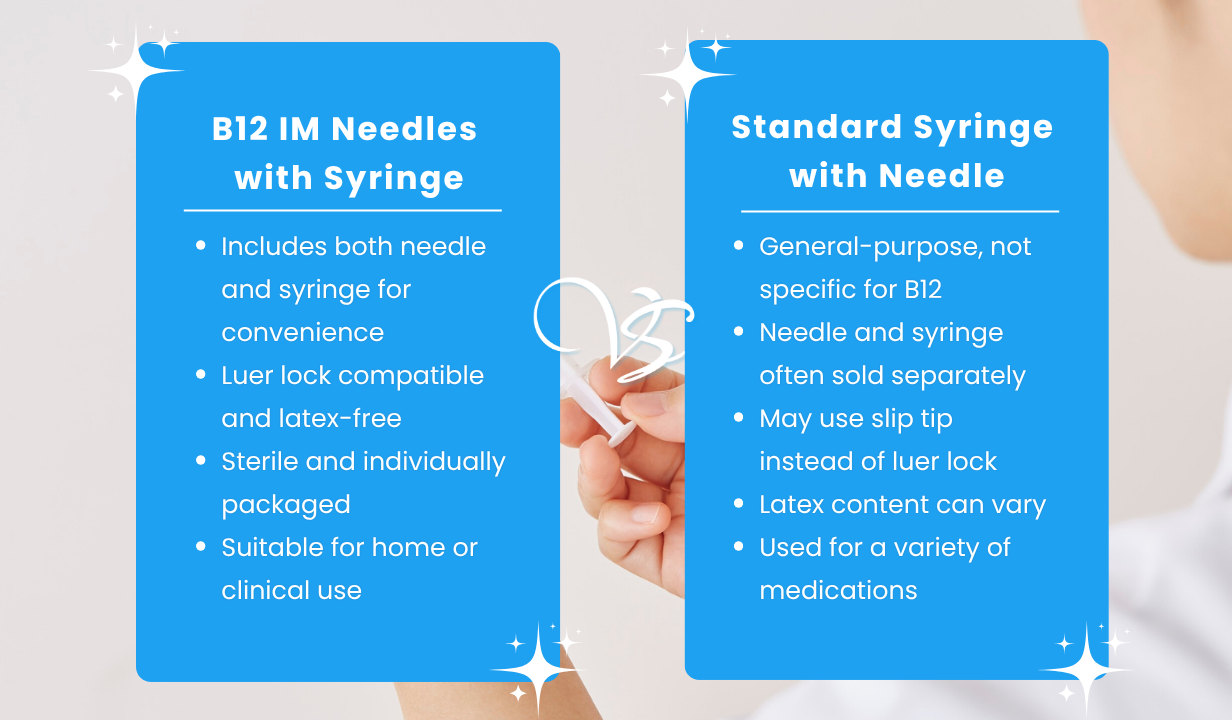
- Needle hub compatibility with the syringe system your product uses (if you buy separately)
- Manufacturer/brand clarity for both the B12 product and the syringe/needle
Consumer note: if you’re shopping for “needle size for B12 injection” supplies separately, look for needle packaging that explicitly lists gauge and length. Generic listings like “thin needle” or “small needle” don’t prevent errors. If the route is subQ, you want a needle length commonly used for subQ—not a random IM needle someone recommended.
Comparison of Common Options
Below is a practical overview of common formats people ask about when searching what size needles for B12 injections. Your exact prescription may specify a different choice, so treat this as a shopping/understanding guide, not a prescription.
| Format | Typical Dose/Use | Pros | Cons | Cost | Best For |
|---|---|---|---|---|---|
| SubQ plan with shorter needle length (general use) | Used for subcutaneous route per care plan | Often feels easier to manage at home; may reduce bruising | If you accidentally use it for IM, placement may be off | Often mid-range for standalone needles | People specifically instructed to inject subQ |
| IM plan with longer needle length (general use) | Used for intramuscular route per care plan | Better matching for deeper tissue targeting | May be more uncomfortable if used for subQ; higher chance of deeper-than-intended placement | Often similar or slightly higher depending on brand/pack | People specifically instructed to inject IM |
| Single-dose vial + separate syringe/needle | Draw up and inject the prescribed mL | Flexible if your clinician specifies needle type separately | Extra steps increase error risk if you’re not trained | Varies widely; supplies add up | People comfortable with prepared workflow and sterile handling |
| Pre-measured injection kit (needle often included) | Inject the included dose as directed | Less guesswork about what size needles for B12 injections | May limit your ability to fine-tune needle gauge/length for comfort | Sometimes pricier per dose | People who want the simplest “use what’s in the kit” approach |
| Smaller-gauge thinner needle (commonly used for comfort) | Chosen when compatible with product viscosity and clinician guidance | Often less intimidating/pinchy for some people | Can feel slower if fluid is thicker; wrong gauge for certain products can be problematic | Often mid-range; depends on pack size | People prioritizing comfort while staying within route and product guidance |
Buying Framework and Red Flags
Use this to shop thoughtfully when you’re trying to answer what size needles for B12 injections without falling into “internet guesswork.” If anything below doesn’t match your care plan, pause and ask your pharmacist or prescriber.
Checklist (printable mindset)
- **Route is confirmed:** Does your instruction say IM or subQ?
- **Needle length matches route:** shorter for subQ plans, longer for IM plans (based on your specific protocol)
- **Gauge is compatible:** the needle thickness is appropriate for the B12 product and volume
- **Injection site matches plan:** thigh/arm/abdomen varies; your provider’s site matters
- **Sterility and single-use:** sealed packaging; no reused needles
- **Syringe compatibility:** hub fits your syringe system; no mixing “almost compatible” parts
- **Expiration dates check out:** both B12 and any packaged supplies
- **You have a fail-safe plan:** what to do if you can’t inject or the solution leaks
Red flags:
- A product that doesn’t clearly state the route or dose
- A needle listing with missing gauge/length details
- Buying “needle size for B12 injection” supplies without confirming IM vs subQ
- Anyone advising you to “use any needle you like” regardless of route
- Unsealed or damaged packaging
:max_bytes(150000):strip_icc()/how-to-select-the-correct-needle-size-for-an-injection-2616536-FINAL-f42600395a324d71b8b3fc4f13f5723d.png)
Common Mistakes and How to Avoid Them
- Mixing up IM vs subQ: The #1 reason people end up asking “what size needles for B12 injections” repeatedly is route confusion. Match needle length to the route your clinician set.
- Ignoring site instructions: Even with the correct needle size, choosing the wrong site can increase soreness and bruising.
- Going too fast: Rushing can increase pain and cause leaking. Inject steadily as taught.
- Using the “thinner needle” obsession: A thinner gauge may be comfortable, but if it’s not compatible with your product and technique, it may increase resistance or prolong injection time.
- Overconfidence after one good session: Needle size decisions should be consistent with the plan. If something feels “off,” stop and reassess with a professional rather than forcing it.
- Skipping sterile technique: Always use new, sterile supplies and follow your training. This is not the place to improvise.
FAQ
Is it proven which needle size for B12 injections works best?
Evidence generally supports that correct route targeting (IM vs subQ) and appropriate needle selection reduce placement-related problems and can affect comfort. But it doesn’t prove one single “best” needle size for B12 injection for every person. Individual factors—like body composition, injection site, and your specific product instructions—still matter.
How long does it take to feel effects after choosing the right B12 injection needle size?
Needle choice mainly affects comfort and correct placement; it doesn’t guarantee symptom timing. If you’re hoping for functional changes (energy, tingling, mood), many clinicians monitor levels and symptoms over weeks. Some people notice changes sooner; others notice little. For any plan, follow the schedule your clinician set rather than timing expectations from the needle size alone.
What side effects can happen if the needle size for B12 injections is wrong?
Common side effects include soreness, redness, bruising, and mild swelling at the injection site. If the needle length or route is mismatched, you may feel more pain or notice more bruising, and occasionally you might experience leakage or incomplete deposition. Seek medical advice if you get worsening redness, heat, pus, severe pain, numbness that doesn’t resolve, or allergic-type symptoms.
Can you combine B12 injections with other supplements, and does it change what size needles to use?
Many people take additional supplements alongside B12, but whether it’s appropriate depends on your health situation and what you’re taking. In most cases, combining supplements doesn’t change what size needles for B12 injections—needle selection is driven by the injection route and product instructions. Still, ask a clinician about supplement interactions and keep your injection plan consistent.
Oral vs injection: is needle size for B12 injections relevant if you use an alternative?
If you choose oral or sublingual B12 instead of injections, then needle size is not relevant because there’s no needle-based delivery. The oral vs injection decision depends on why B12 is being taken (absorption issues, lab levels, and clinician recommendations). If you’re unsure, discuss alternatives with your prescriber.
A Practical 2-Week Experiment Framework
You can’t ethically “test” needle size by ignoring your care plan, but you can run a structured, safety-first 2-week check focused on process: comfort, bruising, and any red flags. This helps you refine your understanding of what size needles for B12 injections without pretending symptoms are guaranteed on schedule.
Set your rules first: use the needle size your clinician specifies (or confirm before changing anything). Keep your injection route, site, cleansing routine, and timing consistent.
- Days 1–3: Do one injection session with your confirmed needle size. Record pain (0–10), redness diameter (rough estimate), and any leaking.
- Days 4–7: Note what you felt in the 24–48 hours after injection (soreness level, bruising, warmth).
- Days 8–10: If your care plan allows only route-confirmed adjustments, you can compare against your instruction set (but do not freestyle). Record the same metrics.
- Days 11–14: Review patterns: Which sessions were easiest? Any repeated bruising? Any unusual symptoms?
If you see escalating redness, severe pain, fever, or persistent numbness, stop and contact a clinician. If your injection is consistently harder than expected, ask a pharmacist or nurse to verify needle length/gauge and your technique rather than changing supplies again and again.
About the Author
Lena Hart is an independent health product reviewer who writes consumer-style guides on at-home administration experiences, including injection supplies, labeling clarity, and what buyers miss when they search “needle size” topics. Her review work focuses on practical safety habits, comparison-shopping, and interpreting manufacturer instructions without hype. She does not provide medical care.
Disclaimer: This article is for informational purposes about product selection and common user experiences. It doesn’t replace medical advice. Always follow your prescriber’s route, dosing instructions, and needle guidance for your specific B12 formulation and situation.
Discussion